FundzBazar
 FundzBazar Login
 Broking Login

Blog Details
Categories


What Missing the Best Days Can Mean for Your Investments

Long-term investing needs patience and consistency, but sticking to the plan is not always easy. At times, an investor may decide to redeem an investment, believing it is the right decision and that they can invest again later. The challenge is that if some of the market’s best-performing days occur in between this missing period, it can affect portfolio’s long-term growth.
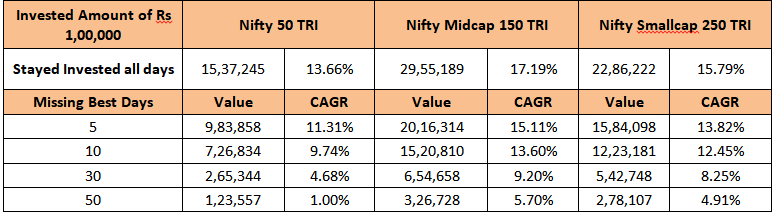
To see how this can affect the investment journey, consider an investor who unknowingly redeems his Mutual Fund Investment one day before a best-performing day and invests again only after that day has passed. If the investor had instead stayed invested throughout the period, an investment of ₹1,00,000 in the Nifty 50 TRI would have grown to ₹15.37 lakh, at a CAGR of 13.66%.
Missing just the best 5 days over the investment journey reduces the value to ₹9.84 lakh and the CAGR to 11.31%. Missing the best 10 days lowers it further to ₹7.27 lakh, with a CAGR of 9.74%, and the impact becomes more significant as more of the market’s best-performing days are missed. A similar pattern is visible in the Nifty Midcap 150 TRI and Nifty Smallcap 250 TRI meaningfully impacting long-term portfolio value.
Why Does This Happen?
In the above example, when investor misses the strong market days, two things happen.
- As the investor redeems one day before the best performing day, the investor misses the gain generated on that day. The gain that was missed never becomes part of the investment value, so it also does not get the opportunity to compound into further returns.
- When the investor re-enters after the market has already moved up, the same amount of money may buy investor fewer mutual fund units because the NAV is now higher. This means future growth will now happen on a fewer units, which can reduce overall investment value.
Over a long period, this can reduce the benefit of compounding and ultimately affect the final investment value.
In reality, the investor may not intentionally plan to miss these days. A temporary pause can happen out of fear, disappointment with recent performance, impatience, or simply the feeling that it may be better to wait for a more comfortable time to invest again. However, the market’s best-performing days cannot be identified in advance, and getting both the exit and re-entry right is difficult. By the time an investor feels confident enough to return, some of those important days may already have passed.
What Can Investors Do Instead?
- Stick to the financial plan: Investment decisions should be guided by goals, time horizon and risk profile, rather than short-term market movements.
- Use SIPs to build consistency: SIP Investment can help investors continue investing regularly and reduce the need to time when to enter or exit the investment.
- Review, don’t react: Portfolios should be reviewed periodically. Changes should be made only when goals, risk profile, time horizon or financial circumstances change.
- Rebalance when required: If the asset allocation moves away from the planned level, rebalancing can bring it back in line without abandoning the long-term investment journey.
Conclusion
Long-term wealth creation generally depends less on finding the perfect day to invest and more on investing consistently and remaining invested even through different market phases. In mutual fund investment, time spent in the market may prove more valuable than repeatedly trying to time the next market move.
- Share Post :


LEAVE A REPLY

Head Office: Prudent House, Panjrapole Cross Road, Nr. Polytechnic, Ambawadi, Ahmedabad - 380 015, Gujarat, India.
- [email protected]
- 1800 419 5051


Prudent Corporate Advisory Services Limited
AMFI Registered Mutual Fund & Specialized Investment Fund (SIF) Distributor
APMI Registered PMS Distributor
CIN: L91120GJ2003PLC042458
AMFI Reg No.: ARN-9992 (Date of initial Registration; 02 September 2003; Current validity of ARN –26 August 2028)| APMI Reg No.: APRN-00423 (Date of initial Registration; 11 August 2022; Current validity of APRN –10 August 2028) | SEBI Stock Broker Reg.: INZ000293634 | SEBI Research Analyst Reg. INH000018115 | SEBI Depository Reg.: IN-DP-477-2020 | NSE Member Id: 90209| BSE Member Id: 6733 | CDSL DP ID: 12090600 | NSDL DP ID: IN304981 | SEBI Investment Advisor Reg.: INA000004906 | PFRDA POP Reg.: POP 10092018 | IRDA Corporate Agent Reg. No. CA0869
* Mutual Fund investments are subject to market risks. Please read all scheme related documents carefully before investing.
Prudent Corporate Advisory Services Ltd. (ARN-9992) makes no warranties or representations, express or implied, on products offered through FundzBazar.com. It accepts no liability for any damages or losses, however caused, in connection with the use of, or on the reliance of its product or related services. Terms and conditions of the website are applicable. Copyright © 2024 Prudent Corporate Advisory Services Ltd.

0 Responses